Kiwi Roy having asked, here are my impressions of the SSR Buccaneer 250i I bought this summer. We all had a discussion about this model a year or so ago, and I investigated it enough that it became irresistible to me. I've got 1800 miles on mine now.
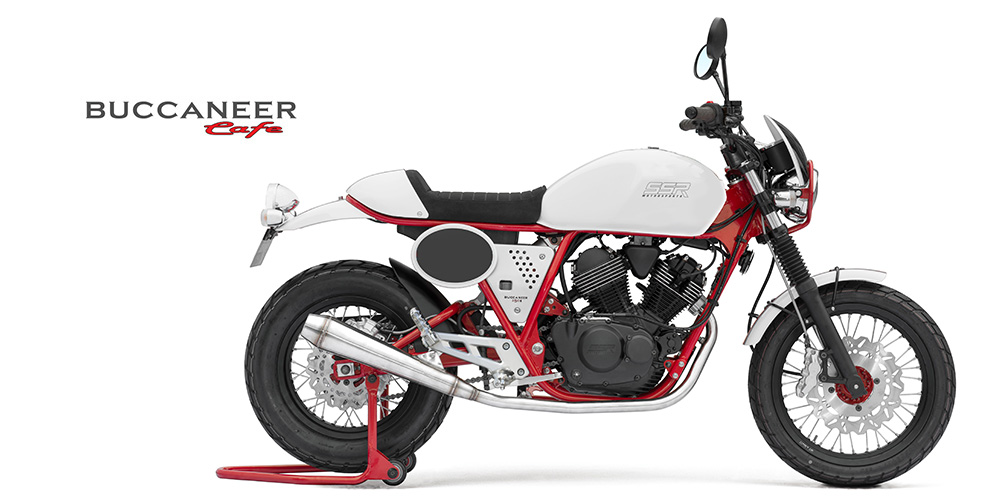
I'll try to organize my thoughts and give a report similar to a magazine road test. Some of my summary comes from material on the internet as well as my own experience.
DesignMy Buccaneer gets a lot of attention, probably at a rate of ten comments for every one that my Griso ever got. It was built by Ningbo Longjia, in China, a different company from the one that builds SSR's pit bikes. Longjia sells some scooters under its own name, and also makes bikes for Genuine Scooters. It has granted Buccaneer distribution rights all over the world, to be sold under different corporate names. Companies sell it as their own in Britain, Germany, Poland, Spain, Cyprus, Malaysia, Thailand, and the Philippines. Only in Cypress and Malaysia is it sold as an Italjet as far as I can tell. Italjet does not sell the bike in Italy, where it presents itself only as a producer of high-end e-bikes. However, the president of Italjet is involved in marketing the Buccaneer in the Philippines and probably elsewhere.
Ningbo Longjia says on its web site that the Buccaneer was "designed by an Italian in cooperation with Italjet." The Italian they refer to was almost certainly Oberdan Bezzi, who has often been vilified by some of us. Bezzi's website shows a design of his that is almost identical to the version of the Buccaneer that was first displayed at EICMA 2015 by Italjet. He also posts a photo of himself with several smiling persons that look a lot like Chinese technicians or designers. The design shows the basic configuration of the final model, but is very ugly I think:

This initial design was apparently built by Italjet and/or Longjia as a prototype. A CAD image of it can been seen on the computer screen of Italjet president Massimo Tartarini in a video about a collaboration with another company. Tartarini is the grandson of Leopoldo Tartarini, the founder (in 1959) of Italjet, who had been a successful racer and designer for Ducati and had also done a round-the-world trip on a Ducati with another rider as a company promotion. Italjet under Leopoldo's leadership had an interesting history of designing and building bikes that used engines from other manufacturers. Italjet was highly regarded for its designs, and examples of two models are now said to be in the permanent collections of two well known museums. Italjet went bankrupt not too long after competing in the world 125 GP championship, but was later resurrected to be run by Massimo.
On the basis of the strong design history of Italjet, and the great beauty of current Italjet e-bikes, I believe it was Massimo Tartarini who transformed Bezzi's ugly duckling into the final version that I own. Tartarini obviously took main cues from Moto Guzzi models like the V7 Stornello and Racer, but produced a result that is more beautiful than the Guzzis, I think. The Buccaneer 250 was named after the Buccaneer 125, an earlier Italjet that sported a Yamaha two-stroke engine.
Because SSR had really nothing to do with the origin of the Buccaneer 250, and because Italjet had a lot to do with it, I regard it to be an Italjet in essence. I therefore applied some Italjet stickers I obtained from Hungary to the gas tank, and may remove the SSR ones in time. Voila! The Italjet Buccaneer 250!
The U.S. and Wisconsin governments call the Buccaneer a Ningbo Longjia, by the way.
ConstructionThe Italjet Buccaneer has a tubular steel frame and many metal components that are plastic on other bikes (like my Griso). The gas tank, front fender, and the headlight rim and shell are all steel. The wheel rims, bash plate and side panels are aluminum. Only the rear fender, the seat core, and the tail light and turn signals are plastic. The relays are Japanese, built in Japan. The drain plug gaskets are solid copper. The chain is a relatively huge 530, as used on much larger bikes. It is not an o-ring chain, probably to conserve scarce horsepower.
Not everything is great. The tank and fender striping is tape, and not applied properly in one spot under the front of the seat. The tachometer needle wobbles as though it needs a bushing. The front suspension squeaks. There is electronic ignition and fuel injection, but the bike runs a little poorly at first on cooler days until it warms up. The front O2 sensor failed for me at 1002 miles, just after the break-in period. It took two weeks to get the new part, but fortunately my dealer, about 50 miles away, arranged things so that I lost no time with the motorcycle in the shop, and was able to continue riding it while waiting for the part to arrive.
One big advantage of the Buccaneer is its engine, which is the long-developed clone of the Yamaha 250 Virago motor, built by Lifan, a different company than Longjia. Lifan has been building it for quite a while, and can be hoped to have overcome initial quality problems. I couldn't really find any substantiated complaints about Lifan's engines on the web, though there were plenty of ominous warnings from those who would never buy one, of course, along with advice to retorque everything upon purchase. A second advantage is that if the engine ever goes south, there are plenty of available genuine Yamaha 250 Vigago engines, and brand new Lifans too, that could replace it. Those, however, are mainly carbureted so far.
One other disadvantage is that there is no service manual available, at least "not yet." The service manual for the Virago is of some use, though not for ECU codes, etc. I seem to have somehow acquired the ECU codes, however, and was able to diagnose the O2 sensor problem that way. The small owner's manual has some useful information including the valve clearance specs and a circuit diagram.
A final strong point about the engine is the earlier development by Yamaha of the SRV250 cafe racer, which produced 27 hp, compared to the 18 hp claimed for the Buccaneer. This means the basic motor is substantially under-stressed, with room for more performance if I want it. In fact the dealer offered the services of their shop to soup it up when I picked up the bike. There is at least one overbore kit taking it to 320cc. I'm thinking I might pick up a Virago motor to hot rod, rather than messing with the pretty nice original.
The brakes are hydraulic disks front and rear, with steel-braided lines. Four pistons front, and one rear. Essentially the same set up as my Griso, except for the addition of the steel braiding. EDIT: And the omission of a second front disk.
The four-inch diameter dashboard is not an integral part of the electronics. Instead, it is really a cheap item available in generic form on ebay for about $30. Griso owners, eat your hearts out! It has a layout somewhat like the Griso's: a largish analog tachometer above a digital speed readout. There is a gas gauge, odometer, separate turn signal indicators, and a gear selection indicator. No trip meters are present, but this is less important with a gas gauge (though it is still missed). No clock or ambient temperature gauge is present.
There is a kit of nine tools in a pouch under the seat and room to store a drawstring backpack, which is great for bringing back a six pack or more from the store. (The Griso has a kit of five tools crammed into a tiny pocket excavated from the seat's padding, and no room for anything else at all.)
Riding Impressions and PerformanceThough it weighs only 320 pounds or so, fully gassed, the Buccaneer feels like, and really is, a full-size bike. The seat is about an inch higher than the Griso's, at 31 inches, which is very noticeable. The light weight makes it easier to ride the motorcycle up onto a lift with confidence, and removes any worries about low speed maneuvering fiascos in other situations.
The riding position, with wide handlebars and very slightly rearset pegs, is also like the Griso's, though there is more leg room. The seat is narrow and hard, compared to the Griso, but I am finding it comfortable, and am never sore after rides of a hundred or two miles. I have ample natural seat padding, I should add. EDIT: I also bought the flat bench seat of the non-cafe model, but realized later that it is too short for my wife's comfort, even though there's a nice YouTube video out there of a young Thai family of three enjoying a ride together.
One astute commenter on my bike noted that it seemed like a dirt bike, and he was right. The Buccaneer, despite being called a cafe racer, is really a traditional scrambler, and is sold as such in other countries. I haven't had much opportunity to use it on dirt roads, but it feels right at home on them.
Vibration is very noticeable through the handlebars on the stock bike. I'm not usually sensitive to this problem, but found both hands were getting tingly after an hour or so. To counter this I installed a "heavy bar-end weight kit" from Moto International, made of the stock weights from the Breva 1100, I recall. This made a great improvement especially at the left handlebar grip. But there is still a less intense vibration in the right grip that somehow put my right thumb to sleep on a 2 1/2 hour trip. My thumb has problems of its own, so maybe it was partly to blame.
The suspension is pretty well damped, which is good since the only adjustment is rear preload. The ride feels rather stiff in town (over our decaying streets) but much more compliant at speed. I don't experience dive or wallowing. Steering is easy with the wide bars and light overall weight, though the rake and trail are relaxed. The motorcycle feels very stable right up to its top speed. It feels like it would be stable for higher speeds too.
The braking is fantastic, by my standards. I think it stops faster than the Griso, though of course there is less mass to decelerate. It is hard to say for sure, without measurement or a side-by-side test. There is no fade in my experience, the levers are firm, and the feel is very good.
Cornering is fun. The suspension and frame do their jobs well. There is more cornering clearance than I have been able to use, which is not surprising considering how narrow the frame is, nine inches at the frame rails. The tires will chirp or slide at about the loads I expect, but they are less grippy than I would like.
Speed is to be attained by conscious effort rather than taken for granted. The top speed in still air, on the level, is about an indicated 75 mph. I haven't checked the speedometer's accuracy, but guess it reads a couple of mph high. If you want more speed, you can lean closer to the tank, or head downwind! I rode back home via a 65 mph posted highway today, against a forecasted 10 to 15 mph headwind. I was able to do 65 or more as a rule, though I did tuck close to the tank sometimes. I'm getting used to riding with the throttle wide open for extended periods, and the bike shows no signs of distress.
The rated peak horsepower, about 18, comes at 8000 rpm, per the manual, so that is where I set my redline. The manual says to avoid running over 7500, which I'm taking to mean any prolonged operation up there. 7500 rpm equals 75 indicated mph.
Even on the backroads in the hilly Driftless Region of Wisconsin where I like to ride I find myself with the throttle wide open much of the time. (Have you taken many corners WFO at full lean lately?) If the speed drops to 60 I downshift and ride the torque back up. This is a style of riding I haven't experienced since my first real bike (not counting my execrable BSA C15), which was a Honda CB160.
The exhaust note, by the way, is pretty loud and raspy. Other reviewers commented that they were surprised it passed the EPA standard. Itsa nice!
I'm getting 75 to 85 mpg, with a 3 1/2 gallon tank. So fill-ups are rare experiences.
Overall EvaluationI love this bike. I remember how much fun I had on that little CB160, and I don't think I really had much more fun on the bikes that followed it. (I would look ridiculous on the 160 now.) True, I've been much faster and felt much stronger forces. I've gone across the country several times, and over mountain passes that the Buccaneer would not do well on. But for running around the backroads of Wisconsin it is a great machine. On my Griso I am always holding back the beast, while on the Buccaneer I am constantly giving it the spur. The speeds are lower, the brakes are as good or better, and the safety is therefore greater. Besides, its beauty is remarked by one and all, or so it seems, and that is pretty nice too.
A Buccaneer coming up the road full chat, Thruxton silencer blaring, 8000 rpm, leaned right over, its goggled rider punching it into 5th as he crests the hill --- this must be a thrilling sight to behold! If only the beholder knew that something like 65 miles an hour was going to be about the extent of it all...
Moto